
Intuitive Geology
Feeling my way through landscapes

I was almost a geology major in college. The geo kids always seemed to have the most fun, and there was something magical about standing in roadcuts and hiking through river gorges, reading the stories of eons past.
As with most sciences, though, I wasn’t as interested in the practical applications (mostly resource extraction) or the intellectual gymnastics of climbing the academic ladder. I just wanted to understand, deeply, this world that I inhabit, so that I could combine that with my own, inner, felt experience. So that my sense of wonder and belonging might be enhanced.
In this time, as I am exploring the southern Appalachians amidst anomalous cold in midwinter, I am finding that the trees, the plants, the insects are largely quiet, asleep, awaiting the upswing of spring. And so it is easier to feel the underlying pulse of the mountains, written in earth and water and stone.
There is a very familiar feeling here, in the bedrock. A sense that each ridge, each cove, each unique spot has its own character. It is a feeling I remember well from childhood, when I would hike to Lookout Rock, Moon Rock, Powder Rock, Sunset Rock, Strawberry Rock, and Whip-poor-will Hill behind my home in the Minnesota River Valley.
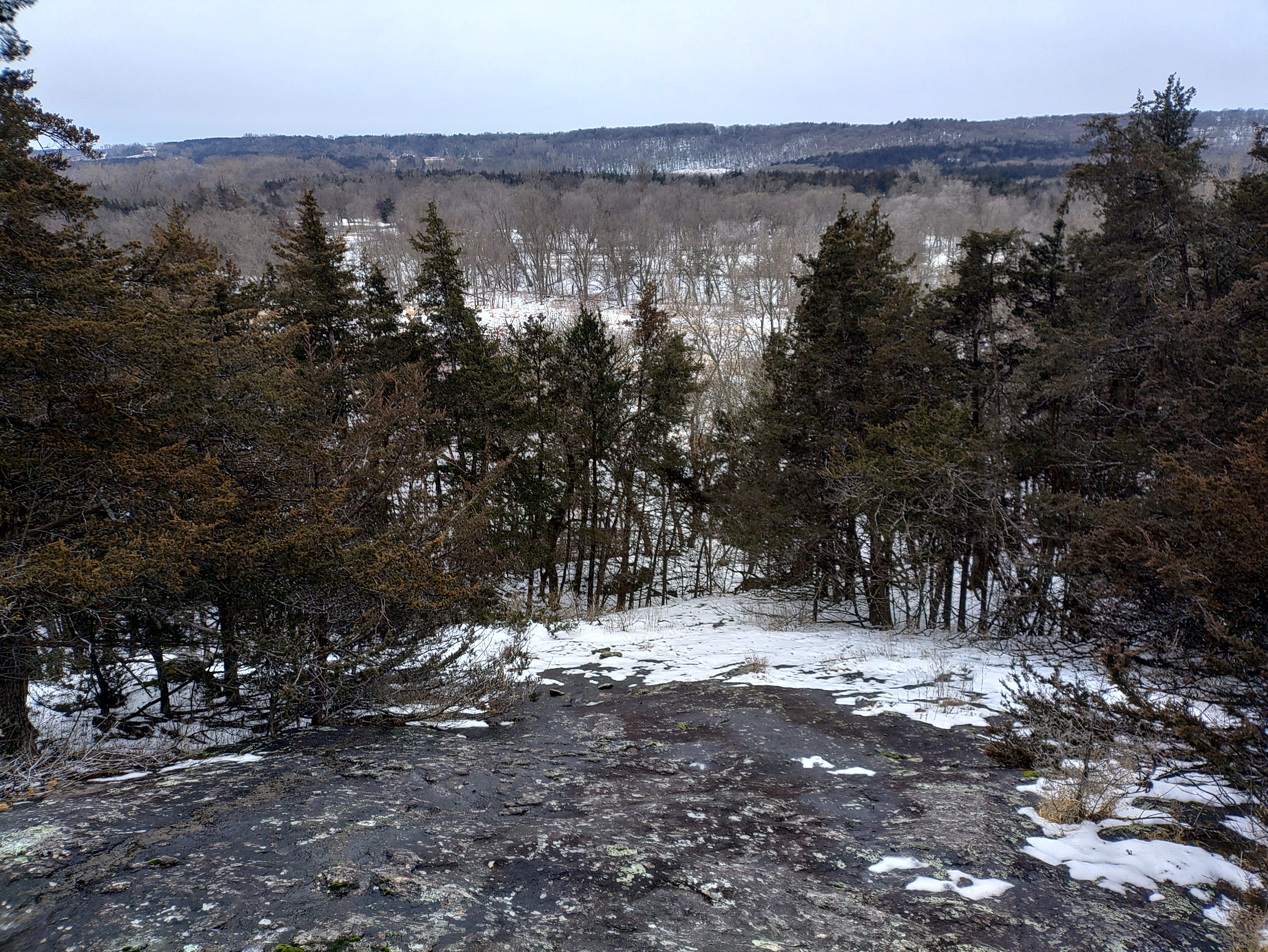
Seventy-two percent of Earth’s land surface is covered by sedimentary rocks. Shale, sandstone, limestone, dolomite. Rocks laid down, layer by layer, over older rocks. In some places these layers extend for miles beneath our feet, and humans, like oversized mosquitoes, poke ever-deeper holes to suck the oil and gas that often hides within, a legacy of ancient life. Sedimentary landscapes are full of memory and story, each vertical inch often holding thousands of years of history, for those who have learned how to read it: fossils, floods, sea level shifts, climate change, distant eruptions and asteroid impacts, tectonic drift. They feel to me a bit like libraries: stable, rich, deep, ancient, but also a little bit stagnant, crystallized, heavy. The molten iron heart of our planet feels somewhat more insulated in these places, buried beneath a thicker skin, beneath millions of years of deposition.
Fifteen percent of Earth’s land surface is covered by igneous rocks. Basalt, granite, andesite, rhyolite, gabbro. Rocks that have hardened from liquid. The frozen blood of our living planet, either cooling slowly below ground or released from volcanoes and vents to flow as lava. Although they vary regionally in color, chemistry, and texture, igneous rocks are always locally uniform. One fragment of basalt or granite looks like any other. They are a blank slate, a canvas upon which new stories will be written, new strata will be laid down. Igneous rocks feel to me like a conduit to the core. Standing and living on them, I feel grounded, connected, light, joyful, unburdened. But they can also feel a bit indistinct, unrelatable, each hill and valley feeling like the next, the great flood basalts covering thousands of square miles in a single regional story.
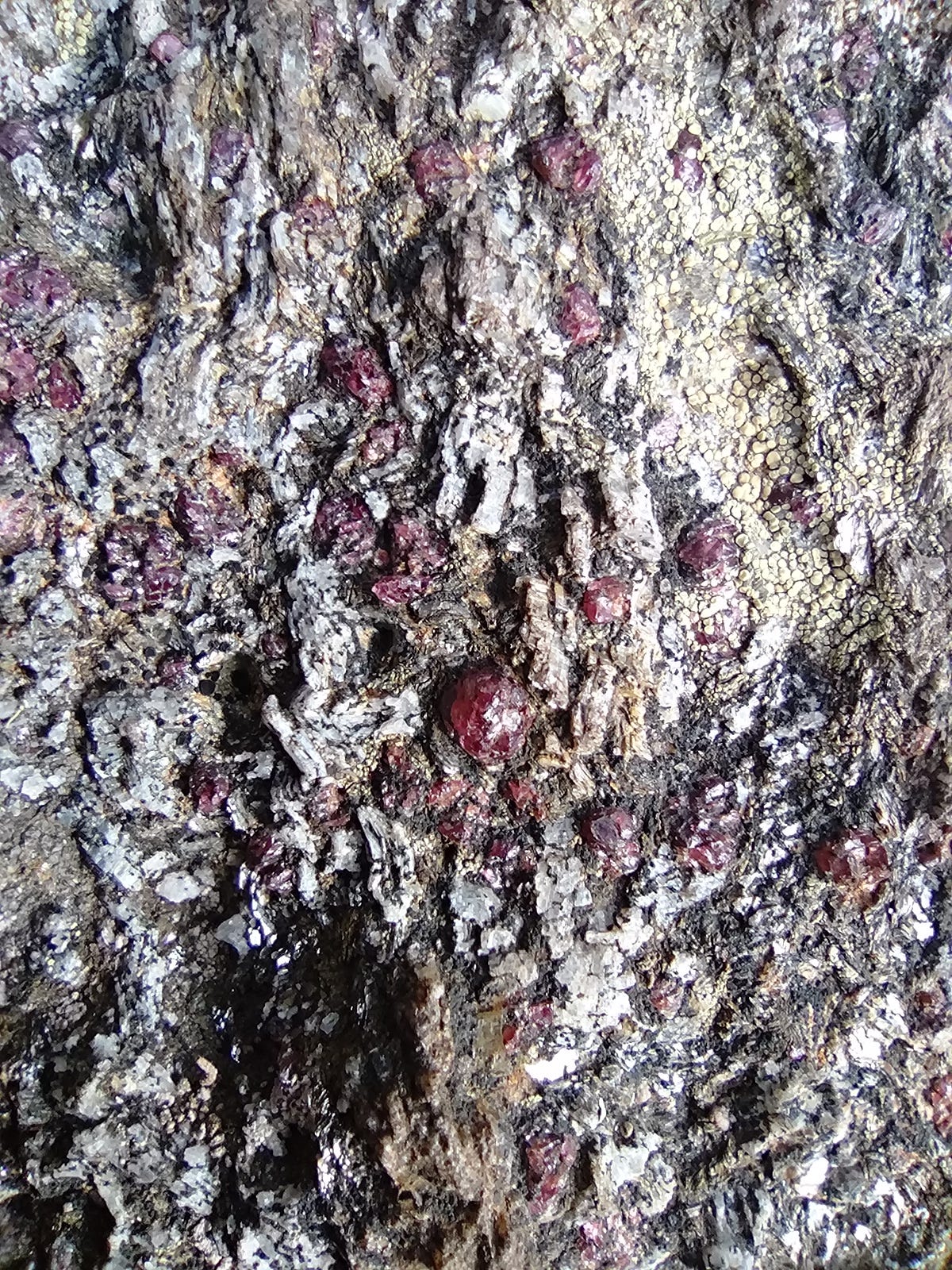
The remaining twelve percent of Earth’s land area is covered by metamorphic rocks. These are rocks that have been “cooked”, under high heat and pressure deep within the Earth, until they dramatically transform. Like the wonder of infinitely unique snowflakes forming in clouds, this is a mystery of beauty and complexity created from simplicity, the underlying conscious and creative structure of matter given freedom of expression. Atoms move, rearrange, recrystallize. Layered sheets of mica grow, creating – when exposed – a sparkling landscape of tiny mirrors. Silicon, oxygen, and metal atoms migrate out of their original minerals, re-aligning into geometric garnets that stud the rock as deep red jewels. Garnet-mica schist is one common metamorphic rock. Another is gneiss, an endlessly variable assortment of black and pinkish layers, folded into waves and whorls – the rock of my childhood home. In a transformative environment, uniform gray limestone becomes endlessly-patterned white marble. Crumbly shale and mudstone becomes slate, then schist. Granite becomes gneiss. Dull sandstone becomes shining quartzite.
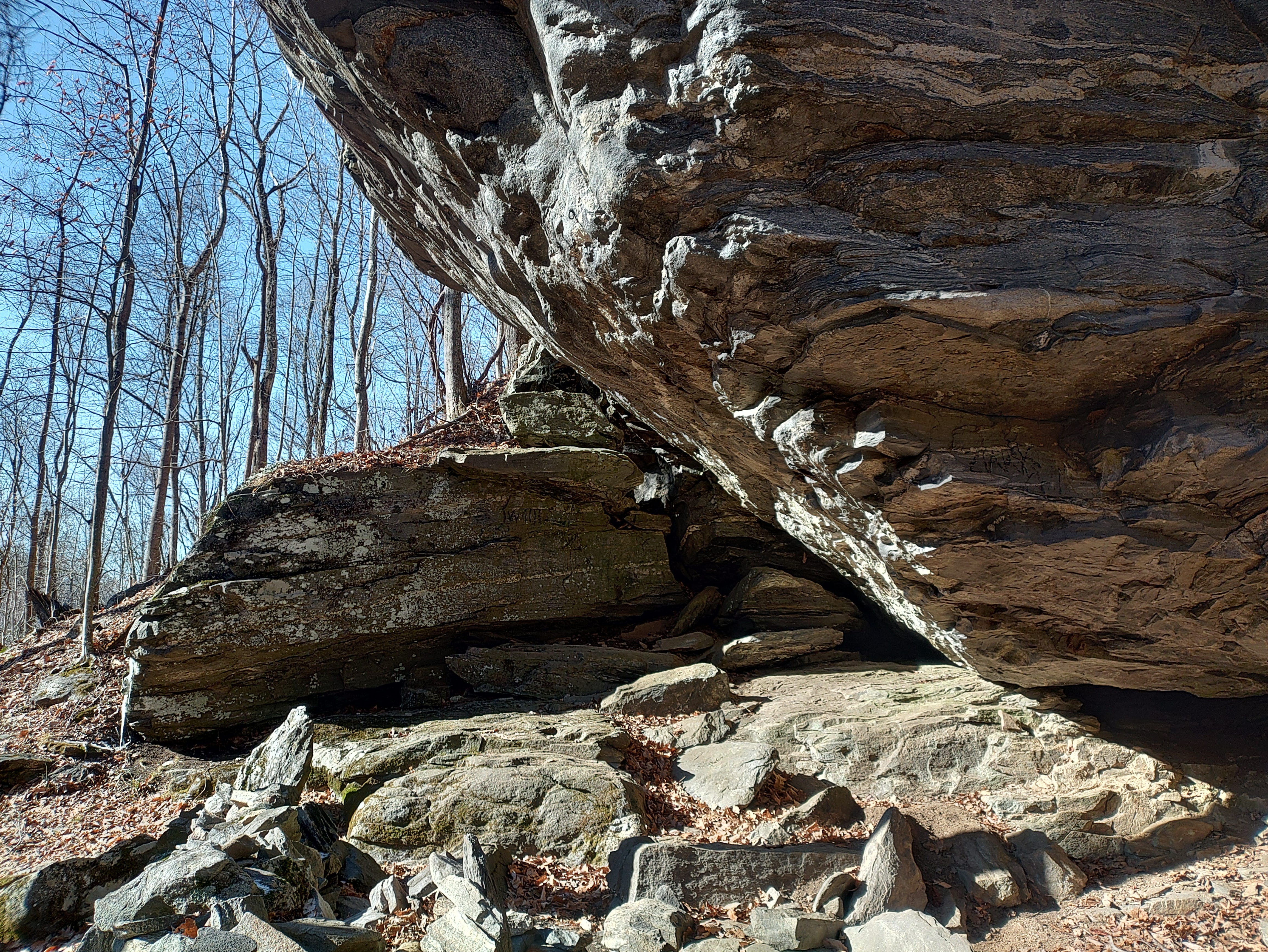
If sedimentary landscapes feel like libraries to be explored and igneous landscapes feel like a blank canvas and a bridge to the living heart of Earth, metamorphic landscapes feel alive. Rock outcroppings appear unexpectedly, wherever the forces of heat and pressure created harder stone. Layers fold at all angles. Weaker zones erode, creating overhanging cliffs. Each outcrop, each angled ridge, each valley has its own personality, its own surprises. Each feels like it deserves its own name, like it can be known, addressed, related to. Metamorphic landscapes feel rich, in a way, like cities full of rock-beings, each waiting to be discovered. Who knows what the next section of stream, the next curve, the next ridge might reveal?
Metamorphic rocks tend to be old, often measured in billions of years, because these metamorphoses take place miles deep, and then the rocks must be uplifted and all of the overlying rocks eroded away – processes that require hundreds of millions of years. Metamorphic rocks form the roots of old mountain ranges, exposed when the high alpine peaks have weathered away to forested slopes. The gneisses of my childhood are among the oldest rocks on Earth, uplifted 2.7 billion years ago in what may have been our planet’s first mountain-building orogeny as the core cooled, the crust thickened, and plates began to form and shift and collide. That is more than enough time for Himalayan-height peaks to erode to a flat plain, waiting for glacial floods to expose the buried bedrock. By comparison, these Appalachian gneisses are youthful, formed a mere billion years past and uplifted 300 million years ago, their topography still sharply incised, their atoms still shifting steadily seaward.
Fifteen years ago I spent a couple of weeks in Sweden, and the gneiss boulders there felt familiar, strangely homey, despite being half a world away. I am discovering a similar feeling here in the Blue Ridge Mountains, the ancient metamorphic core of the southern Appalachians. Gneiss feels like home to me, I guess.
What do you feel, as you explore different rock landscapes?
What geology feels most joyful to you? Most resonant? Most comforting?
Winter’s grip still holds strong, at least across the eastern US, but the days are growing rapidly longer and the dark quarter of the year is now behind us. At 3:03pm eastern/12:03 pm pacific today, we cross the threshold in our orbit that is halfway between the winter solstice and spring equinox. Happy Imbolc, however you choose to celebrate!
I am a sucker for a talus slope. I love hiking in granite country, watching it glisten in the sun. Smelling the timelessness of the lichen baking on the rocks in the heat of summer.
Different landscapes also feel very different to me, and although rock is not the only factor I do notice the difference myself. I like your description of areas with igneous rocks as being mord connected to the core of the Earth. One particular spot that isn't widely known has felt particularly strong to me. Once I passed through the Wichita Mountains of southwestern Oklahoma, a range of small granite peaks that rise out of the plains. I camped for one night and took a hike the next day, then moved on.
As soon as I got there, it felt like an unusual intensity of presence, even compared to other areas with granite. I had some of the most vivid dreams of my life that night, including perceiving smells in a dream. On my hike, I found a small patch of sugar maples, which was how I'd first heard of the Wichitas, as they have a disjunct population of sugar maples that are far to the southwest of other wild populations, a relic of the ice age.
I hope to go back to the Wichitas again some day.