
To Hold and Be Held
Toward sovereign belonging

For twenty years before I was born, my father was a wilderness guide, youth mentor, minister, teacher, curriculum developer, community leader, songwriter, and musician. A man with a full social calendar who frequently set off on all-day drives to events and conferences.
I wish I had been able to know that man.
Ed Stone was a most excellent father - I have no regrets - but the man I knew had a much diminished sense of confidence, seldom traveled far from his valley home, kept a small circle of friends, and eternally struggled to bring his visions to fruition.
A few things shifted in his life between those stages - a surprise induction into fatherhood being one of them - but perhaps the most significant was that he left the priesthood and the Catholic Church. Or the church left him. Or both. I think it could reasonably be said that the separation was mutual.
His journey away from the church is a story for another time, but one with echoes in most of our lives: growing into our own deeper truth, finding ourselves out of alignment, letting go of that which feels secure in favor of that which feels most authentic. Part of that journey is learning to hold ourselves, to source our power and truth within, to discover - in the depths of our being - that we are loved and are love. That we are - as we are - always enough.
Exactly one year ago I published an essay and poem titled To Be Enough, following shortly after Love, Expanding. And Hannah King, who is usually on the same wavelength, recently shared Becoming Mountains, as her own expression of wholeness and enough-ness.
I am recognizing how wholeness is not an idea, but a felt sense. We can know a thing in theory, but there is dimensionality to physicality, and much of what is tangible is also unseeable. I felt the changing, and it feels like what brings tears to bubble up from my eyes from some depth of knowing and laughter that pours out simultaneously, because this knowing is coming from within, and the closest word I can come up with to label it is love—a rearranging and merging with a force that lifts the spirit into form, stabilizes and flourishes.
—Hannah King, from “Becoming Mountains”
Let this be the counterpoint, the “yes, and” to discovering our own wholeness.
What we achieve, in breaking free from old patterns, in feeling an inalienable fullness within, is a sort of agency and sovereignty. An ability to consciously choose in resonance with our own deepest self, without being magnetically and unconsciously pulled into codependencies that compensate for our missing pieces.
Yes, and.
Yes, and, this is not the same as independence or radical self-reliance. It is easy to venture down that path, as my father did after leaving the church. It is especially tempting for those of us who are no longer willing to compromise to fit into boxes, or who are on some level afraid that stepping back into relationship or into community will also entail stepping out of integrity with ourselves. But that path, too, is ultimately limiting - a box of our own making, with a membership of one.
Yes, and, there is value in being held in community, in belonging, that does not reduce to a security blanket, an outsourcing of self in exchange for validation. Structure that we don’t have to create. Financial support. Seeing and being seen. Showing up for each other. Sharing foods and skills and ideas relationally instead of transactionally.
Within the Catholic Church, my father had guaranteed financial stability, respect and recognition among people he had just met, a steady supply of folks interested in his programs, and a clear sense of belonging. As long as he was willing to squeeze himself into the box. To accept their theology as truth.
Outside of the Catholic Church, my father did his best to replicate his previous work - to offer courses, publications, spiritual support to others on their journey - and almost nobody listened. More people offered skepticism than respect, subscriptions grew very slowly, events seldom brought more than ten people, and money dried up.
We are held within many kinds of social containers. Marriages, extended family, workplaces, institutions, cliques and circles of friends, churches. And - too often - we stay in containers that no longer align with us, or we even tolerate harm, because a flawed container feels better than no container. Or we discover, after having left, that we are free but no longer supported, in ways that we previously took for granted.
We are slowly, I feel, discovering that to hold and be held need not be coupled to romance, bloodlines, memberships, employment contracts, or any such thing. That it is possible to simply choose to open space, to invite others in. That it is possible to hold others in ways that do not force them into a box. That it is possible to be held in ways that do not constrain alignment and authenticity.
Circles of women, as Hannah is finding. Circles of men, as organized by my friend Jon. Cuddle clubs, as created by my new friend Ishka. Cohousing and intentional communities, as I am now exploring. Co-working spaces. The stronger we can build these, the more belonging and support can be waiting with open arms - asking nothing of us except that we show up as our whole selves - the easier it becomes to step out of containers that no longer suit us, the weaker the old patriarchal control structures become.
As we are held in smaller groups, so too are we held in human geographies, in the “vibe” of a place. And one of the reasons we move is to find a place that holds us, that aligns, more deeply. I moved recently first and foremost following an intuitive calling. But I also moved, it is fair to say, because I no longer felt held by the “vibe” of Corvallis.
Corvallis, Oregon held me well through my graduate research, through my transition to seed farming, through my launch of the Winnow Wizard business. Those were all deeply in alignment with community values, with the collective consciousness of the area. But then I started to shift out of my mind, out of analytical thinking, and into presence and intuition.
Corvallis is a mind place, a college and research town with one of the highest proportions of PhDs in the country. It is a place where credentials matter, where even the folks out mowing and weeding are expected to be licensed and insured, where every renovation gets permitted and inspected, where the yoga teachers and counselors cite their certifications and approved methods, where going back to school is the usual first step in shifting paths. It is a place where most people are a bit confused by my own path, my inner guidance, my absence of strategy.
Where I am living now, credentials seem far less important, and most folks at least out in the country don’t seem to bother with permits and codes and inspections, choosing instead to simply create what works best for them. This is a place where “I left my corporate job to follow my soul calling” is a surprisingly common story, where there seems to be much less focus on orderliness and more acceptance of organic chaos.
Another difference I have noticed is in the relationship to boundaries, landownership, neighborly relations. Out west, there is more of a sense that boundaries are very important, and rural neighbors are surprisingly seldom friends, each tending their own little empires. Here in southern Appalachia, most property boundaries are unmarked, and neighbors’ dogs that wander over are usually met with friendly curiosity.
This region also carries in its recent memory the social experiment that was Hurricane Helene - a time when the structures that hold us transactionally - grocery stores, utilities, roads - became inaccessible for nearly a month. And so neighbors learned to hold each other relationally, to ensure that everyone’s basic needs were met, to reclaim the responsibility of care and support that we too often outsource to the system. The impersonal, extractive economy of buying and selling that would reduce us all to producers and consumers of value, commodified and interchangeable.
I am still weaving in here, still a bit unsure of my place. And yet there are ways in which I already feel well held, that would not have come as easily in my previous home. Ways in which I am beginning to hold others, as well.
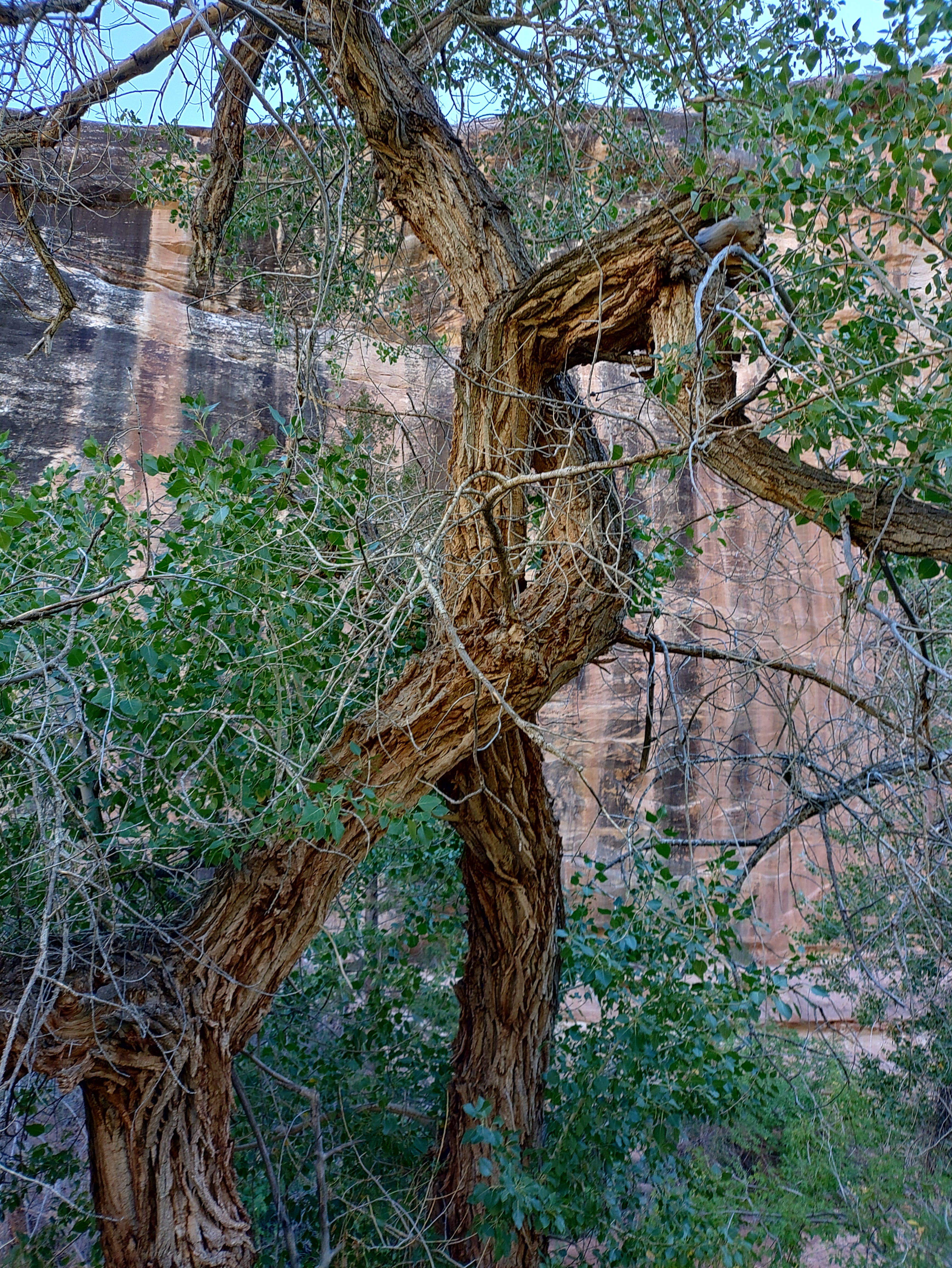
As we are held within groups and within wider human geographies, so too are we held within the wildness that surrounds us: rivers, trees, birds, seasons, ecosystems, weather, scents, sounds, flavors. And here too there is a “yes, and” at play.
Yes, we can deepen our connection to place over years, generations, even centuries. We can notice ever-smaller details, give names to each rock and glen and twisted tree, develop the wisdom that can only grow across cycles upon cycles: how a place responds to flood and drought, how the timing of blooms shifts subtly from year to year, how a place feels when layer upon layer of experience and memory has woven into its tapestry.
And, we are Earthlings. Wherever we are, on this planet, we are home. We can grow roots quickly in new places, fall in love with new creatures, feel the same current of aliveness that runs through mountains and plains, rainforests and deserts.
I felt deeply held in the Minnesota River Valley for my first 18 years, and in the hills and valleys of western Oregon for my most recent 18 years. But I also felt held in the deep woods of southeastern Minnesota, in the high prairies and cloud forests of Ecuador, and in the mountains of Colorado and Wyoming - places that I called home for much shorter spells. And I already feel held, very deeply, in my new home.
My father chose place over community. He chose to belong fully to his valley home for the final 38 years of his life. I am grateful for this, in a sense, because I could not imagine a better playground for a child like myself than the cliffs and rocks and creeks and woods and riverbanks that started right out our back door. But I also sometimes wonder what my childhood would have been like if he had chosen community. If we had moved somewhere with more like-minded people, where his gifts could have been appreciated.
I don’t believe there are any right answers here. Some of us will choose to be people of place for our whole lives, and others will choose to be nomads, feeling at home wherever our feet touch the ground. Some of us will gravitate toward mind and structure and order while others will embrace wildness and chaos. Some of us will find belonging in intentional communities while others will live among generations of extended family.
There may be no right answers, but there is weaving and crystallization, flow and rigidity. We can feel trapped by our circumstances, our fears, our habits, our patterns, or we can feel free to choose and create the belonging that feels most resonant, most aligned with our true nature.
And so my question to you, for your own musing, is this:
Do you feel free to hold and be held, as you would like to hold and be held?
And
If not, what is standing in the way? And how might that change?
Everytime you write, some new awareness opens in me. Thank you, Markael. May you be held in peace and love wherever you are.
Reading this as the sun rises over the hills and fog lifts from the river. As always, your writing is beautifully insightful. More of a nomad during the last twenty years, recently I have been waking up to the realization of how held I am within the larger earth field. And this has arrived with the recognition of home in multiple locations, deeply so in NV. There was a particular moment 3 or so years ago when, looking out over the valley, I could feel how the midwestern hardwood forests were a part of my inner ecology, and that now it was time to be held by another kind of land…desert, mountains. And even still, having returned to the river for the fifth summer I feel deeply held within the constellation of relationship and layering of time and experience.
I notice, wherever we go, sooner or later we find ourselves within community. The magnetism towards holding and being held seems like a natural and strong inner tide.
Thanks Markael for this lovely contemplation.